ACE Credits Charities for Policy Changes They Didn't Cause
Accurate as of: Jul 12, 2026
Animal Charity Evaluators (ACE) is the largest charity evaluator in the animal protection movement. Much of ACE's influence stems from its big impact claims—such as claiming one ACE recommended charity can help hundreds of pigs with $1.
While it would be great if this were true, ACE's claims rely on crediting charities for policy changes they did not actually cause.
Problem Overview
Every year, institutions around the world announce policies. ACE finds these policies, and assigns charities credit for causing them.
However, in many cases the charities did not cause the policies, and ACE still gives them significant credit.
For example, recently ACE gave a charity credit for getting a large meat company (Alibem) to ban the use of surgical castration on pigs. However, Alibem had already banned the use of surgical castration in 2010, and the charity hadn't even been founded until 2017. Despite this discrepancy, ACE still credited the charity for helping millions of pigs through this policy.
This leads us to an important question: how does ACE determine a charity caused a policy?
How Does ACE Determine a Charity Caused a Policy?
In most cases, ACE does not provide specific details regarding how a charity caused a policy. The most common reason we've seen ACE give for this is that they can't specify what work a charity did, since it is "confidential."
However, in one instance ACE accidentally published the "confidential" work a charity did to cause a major policy change:
"We launched the campaign on Halloween, taking advantage of the theme 'Terror at Habib's,' with a street action featuring people dressed as haunted figures and an LED truck… In December, we did another street action for Christmas, with a spooky gift walking through the streets of the city and stopping in front of the restaurant's locations. On that occasion, we used a sound truck with a Christmas jingle, mixed with the screams of pigs in crates."
According to a spreadsheet ACE used to assign credit, this work was 90% of the reason that Habib's (the largest Arabic restaurant chain in the world) implemented a major animal welfare policy.
In reality, there is no reason to believe that "a spooky gift walking through the streets of the city" is what causes massive corporations to make major policy changes. In spite of this, ACE has spent years pushing the idea that work like this is the driving force behind policy change:
Note: The Humane League (featured above) has been an ACE top charity for over 10 years. According to ACE: "The Humane League (THL) drives corporate and legislative change for farmed animals worldwide."
To receive updates when we publish new articles, subscribe to our newsletter below for free.
Related Articles
Why ACE's Metrics Are Not Grounded in Reality
ACE advertises metrics that tell donors they can have a massive impact. Unfortunately, these metrics are not grounded in reality.
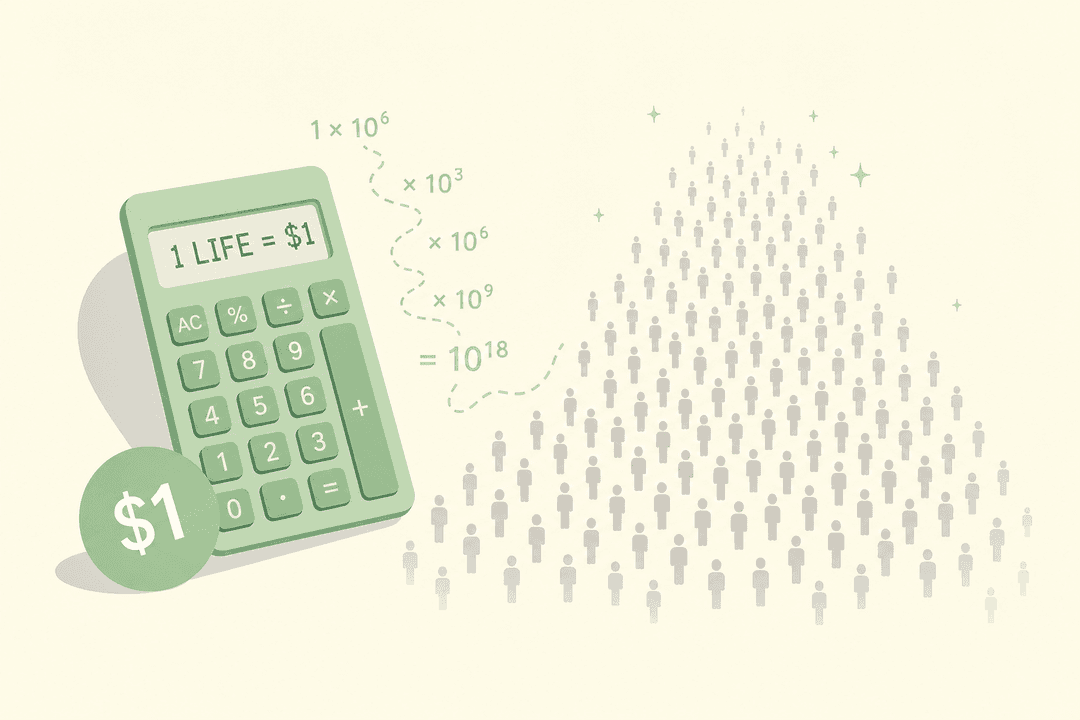
$1 to Save Billions of Lives? The Fantasy Math Behind Effective Altruism
Any metric can be calculated by using fantasy math, and that's what EA is built on.

Animal Charity Evaluators Knowingly Uses False Data
A metric is only as good as its underlying data, and that's why ACE's use of knowingly false data is quite concerning.

Charity Evaluators Are Incentivized to Lie About Impact Metrics
As a whole, charity evaluators that publish impact metrics are structurally incentivized to exaggerate. This means that in many cases the metrics are marketing material rather than objective analysis.
ACE Hides Evidence, Resulting in Unfalsifiable Metrics
When ACE hides evidence, their metrics become unfalsifiable. And while this is good for ACE, it is bad for donors.
Former ACE Employees Accuse Them of Bias
Ex-ACE employees have raised concerns about the fairness of Animal Charity Evaluators. Are these concerns legitimate?

FarmKind and ACE Are a Self-Promotion Loop. Here's Why Donors Shouldn't Trust Them.
FarmKind markets themselves as independent, but they only recommend charities that have been recommended by ACE.
References
Note: see Cell D26 under the "Pig welfare campaigns" tab.
Key Quote: "Maintain immunocastration instead of surgical castration – a procedure that was voluntarily eliminated from the Company’s protocols in 2010."
Note: Sinergia states here that they were founded in 2017.
Note: see Cell K4, Cell Y4, Cell AA4, and Cell AC4
Note: here, ACE avoids providing specific details, citing confidentiality.
Note: in this statement, ACE says: "During ACE's evaluations of charities, we often redact information that charities provide us before publication on our website. In this particular instance, Sinergia had requested that we remove this column last year during their evaluation for confidentiality reasons related to their work, but we missed it in this particular case." This is in reference to the deletion of a column in a spreadsheet that contained the work the charity (Sinergia) had done to cause Habib's to implement a major animal welfare policy.