Why ACE's Metrics Are Not Grounded in Reality
Accurate as of: Jul 24, 2026
Animal Charity Evaluators (ACE) is the largest charity evaluator in the animal protection movement. As part of their work, ACE calculates metrics that tell people how many animals their donations help:
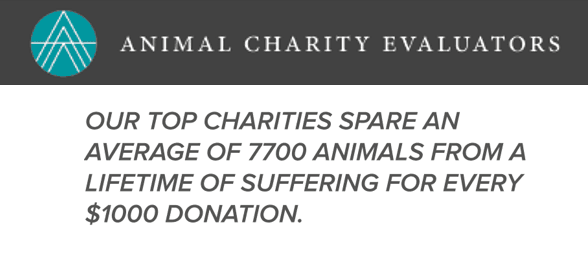
At face value, the idea of calculating the impact of animal charities seems promising. After all, if you can save 10x more animals by donating to one charity instead of another, you'd naturally want to donate to the more impactful option.
However, there's a serious issue with this approach: not all forms of charitable work can be quantified.
Take Faunalytics, a charity that manages an online research library (basically an online list of research articles).
In one of their evaluations, ACE calculated the impact of Faunalytics' research library. Their analysis suggests that Faunalytics' research library spared 227,556 animals in a single year—equivalent to 5.9 animals spared per dollar spent on the library.
These numbers sound amazing, but there's a key problem: they have no grounding in reality. The idea that you can calculate how many animals were "spared" by an online list of research articles is complete nonsense. It is impossible to know how many animals, if any, were spared by this work.
So how did ACE calculate these metrics? Simple. ACE assumed that each subscriber to Faunalytics' research library resulted in 42 animals being spared, then multiplied this by the total number of subscribers.
The Biggest Assumption Wins
The core problem with ACE's metrics is that they are based on unverifiable assumptions. As a result, ACE can reach any cost-effectiveness number simply by changing their assumptions (e.g. assuming 500 animals spared per subscriber instead of 42).
And who gets the best assumptions? Well, according to statements from former ACE employees, ACE promotes "organizations run by their friends" and makes decisions that have "absolutely nothing to do with evidence."
This means that many of ACE's metrics may not just be baseless, but also the result of favoritism.
Over 10 Years of Bad Math
The calculations discussed above were created over 10 years ago. Yet even today, ACE continues to produce similarly flawed calculations.
In one of their recent charity assessments, ACE claims that the "Cage-Free Accountability" program shown below "is likely to help 11 egg-laying hens per dollar."
It is implausible that work like this helps multiple animals per dollar. And when ACE publishes baseless metrics like this, it harms not only donors, but also "average" animal charities—who ACE has marketed as 100x less impactful than ACE recommended charities:
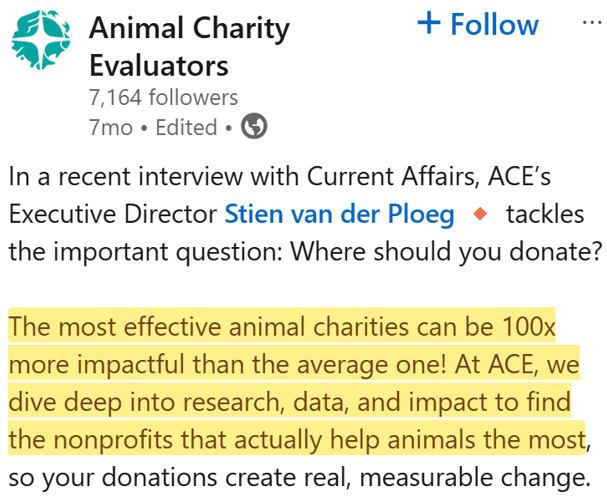
This works great for ACE and their recommended charities—but not for the rest of the animal protection community, which is forced to compete with metrics that are not grounded in reality.
To receive updates when we publish new articles, subscribe to our newsletter below for free.
Related Articles

Animal Charity Evaluators Knowingly Uses False Data
A metric is only as good as its underlying data, and that's why ACE's use of knowingly false data is quite concerning.
$1 to Save Billions of Lives? The Fantasy Math Behind Effective Altruism
Any metric can be calculated by using fantasy math, and that's what EA is built on.

Charity Evaluators Are Incentivized to Lie About Impact Metrics
As a whole, charity evaluators that publish impact metrics are structurally incentivized to exaggerate. This means that in many cases the metrics are marketing material rather than objective analysis.

ACE Credits Charities for Policy Changes They Didn't Cause
Every year, thousands of institutions announce policies. ACE finds these policies, and credits charities for them.
ACE Hides Evidence, Resulting in Unfalsifiable Metrics
When ACE hides evidence, their metrics become unfalsifiable. And while this is good for ACE, it is bad for donors.
Former ACE Employees Accuse Them of Bias
Ex-ACE employees have raised concerns about the fairness of Animal Charity Evaluators. Are these concerns legitimate?

FarmKind and ACE Are a Self-Promotion Loop. Here's Why Donors Shouldn't Trust Them.
FarmKind markets themselves as independent, but they only recommend charities that have been recommended by ACE.
References
Note: Cell C25 and Cell C32 multiplied together equals 227,556 animals spared.
Key Quote: "The most effective animal charities can be 100x more impactful than the average one! At ACE, we dive deep into research, data, and impact to find the nonprofits that actually help animals the most, so your donations create real, measurable change."
Key Quote: "Cage-Free Accountability (U.S., Global, and U.K., for commitments for egg-laying hens). Our CEA indicates that this work is likely to help 11 egg-laying hens per dollar through driving a transition to cage-free systems, equating to 88 Suffering-Adjusted Days (SADs) averted per dollar (range: 17–351)"