Charity Evaluators Are Incentivized to Lie About Impact Metrics
Under traditional economic models, people are predicted to lie when it is rewarding and undetectable.
Real life is a bit messier. Some people try to be honest, and this gives the opportunity for liars to gain an even larger advantage over their competition.
For charity evaluators, this dynamic plays out brutally due to three key issues.
Issue 1: Lying About Impact Metrics Is Easy to Get Away With
Donors rely on charity evaluators' claims, and detecting lies from charity evaluators is extremely difficult.
For example, a charity evaluator might claim that your donation gave 100 homeless people sandwiches. But how could you detect if this is a lie? As a donor, you never get to see the sandwiches, or the homeless people being fed. This means that if the charity evaluator lied, you won't know that you've been deceived, and you'll likely keep trusting them, unaware that the claimed impact never happened.
In contrast, if a business lies about giving you a sandwich you paid for, you'd immediately notice and stop shopping there.
Overall, donors are among the easiest customers to deceive, since they don't get to see the product or service they are paying for.
Issue 2: Charity Evaluators Are Rewarded for Claimed Impact, Not Actual Impact
Imagine two charity evaluators who are trying to find the best charities:
- Evaluator A claims their recommended charities can save 1 animal with a $1,000 donation.
- Evaluator B claims their recommended charities can save 5,000 animals with a $1,000 donation.
Most people would assume that Evaluator B did a better job at finding impactful charities, and would favor supporting them instead of Evaluator A.
But isn't it also possible that Evaluator B is just lying?
Ultimately, lying allows charity evaluators to make impact metrics that are higher than what is physically possible. This makes lying a dominant strategy.
Issue 3: How Charity Evaluators Make Money
Charity evaluators make money by influencing where donations go.
If a charity evaluator influences only $1 in donations per year, no one will pay money to keep the charity evaluator operating. However, if a charity evaluator influences $10,000,000 in donations per year, the charity evaluator carries real financial importance, and people will be willing to pay money to support their operations.
And why is this a problem? Because inflated impact metrics make it far easier to influence donations.
Conclusion
As a whole, charity evaluators that publish impact metrics are structurally incentivized to exaggerate. This means that in many cases the metrics are marketing material rather than objective analysis.
For this reason and many others, we recommend donating to charities based on strategies, not impact metrics.
To receive updates when we publish new articles, subscribe to our newsletter below for free.
Related Articles
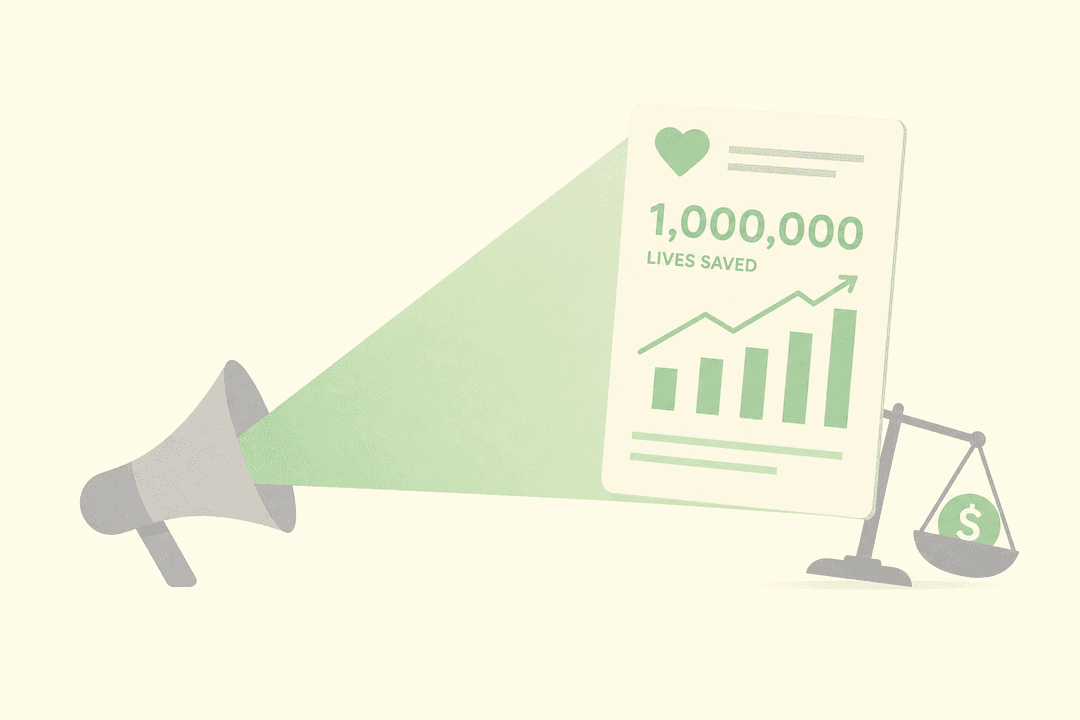
Charities Are Incentivized to Lie About Impact Metrics
As a whole, charities that publish impact metrics are structurally incentivized to exaggerate. This means that in many cases the metrics are marketing material rather than objective analysis.

Why Donors Get Fooled: 5 Principles Every Donor Should Understand
Many donors want to help others, but struggle to have an impact. If you want your donations to actually make a difference, here are 5 key principles every donor should understand.

Charities Rationalize Lying, Honest Charities Suffer
Many people working at charities want to do good. That's great! But unfortunately, this desire to do good makes it easy to rationalize dishonesty.
When “Trust the Experts” Fails
There's a common piece of advice we've all heard: “Trust the experts.” And in some cases, it's exactly right. If a chemistry PhD tells you that drinking a certain chemical will kill you, you should probably believe them.