Animal Charity Evaluators Knowingly Uses False Data
Accurate as of: May 5, 2026
Animal Charity Evaluators (ACE) is an organization that builds models to calculate the cost-effectiveness of charities.
As part of their calculations, ACE knowingly uses false data. We will provide two examples of this below.
Example 1: The Largest Meat Company in Brazil
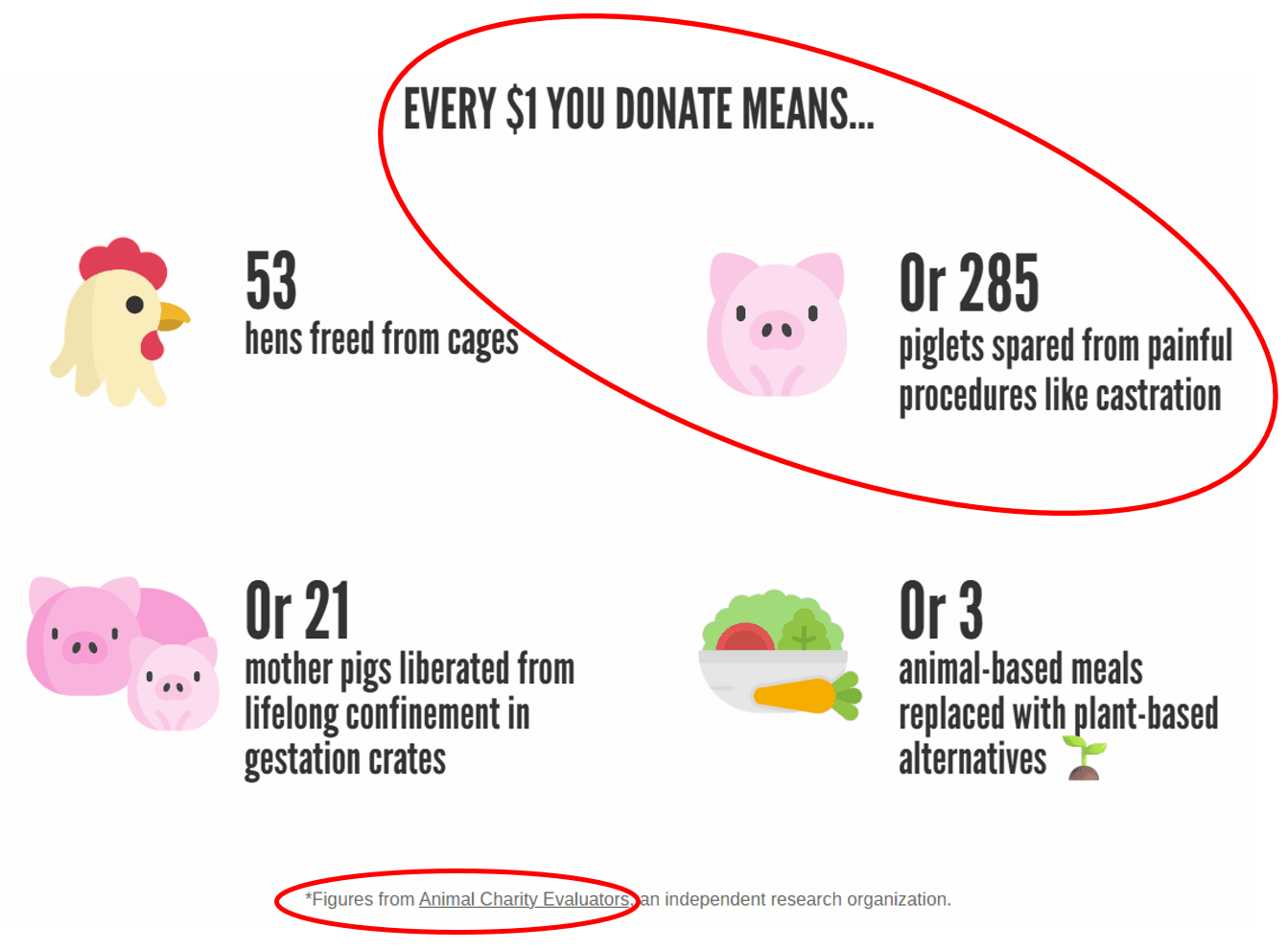
Recently, ACE calculated that the charity Sinergia Animal is so cost-effective that they can help 285 piglets with just $1.
As part of this calculation, ACE credited Sinergia for getting JBS (the largest meat company in Brazil) to commit to stop ear notching pigs by 2023.
The only problem? JBS never committed to this, and both ACE and Sinergia admit this.
Given that this inaccuracy results in ACE crediting Sinergia for helping millions of JBS pigs who were never helped, one would think this is an important issue to correct. However, in 2025 ACE announced they weren't going to correct their calculations because "the magnitude of the change would not affect [their] decision to recommend Sinergia."
As a result, the flawed 285 piglets per dollar metric continued to be advertised by both ACE and Sinergia for over a year.
Example 2: Contradictory Legal Deadlines
The calculations mentioned in the previous example also contain a separate issue, which we will now cover. In these calculations, ACE initially claims that the legal deadline to stop teeth clipping pigs in Brazil is 2030, and bases multiple calculations on this deadline.
However, later on in the same model ACE changes the legal deadline to 2045, and performs additional calculations based on this revised deadline.
ACE cites Brazil's Normative Instruction 113 as the source for both of these legal deadlines. But if you read Normative Instruction 113, it explicitly states that teeth clipping pigs has been prohibited since February 1, 2021, which is years prior to both 2030 and 2045.
How did this happen? Well, according to ACE, incorrect legal deadlines were used "for simplicity."
This means that ACE knowingly used false legal deadlines in their calculations, and the resulting metrics are not grounded in reality.
Closing Thoughts
ACE's metrics are supposed to help people decide which charity to donate to. But if ACE is fine with using false data, then how can their metrics be trusted?
Additionally, a number of ACE's calculations rely on "confidential" data. In these cases, the public has no way to check whether ACE's data is true, and no way to uncover issues like the ones above.
This combination of secrecy and knowingly false data makes ACE's metrics inherently untrustworthy.
To receive updates when we publish new articles, subscribe to our newsletter below for free.
Related Articles
Why ACE's Metrics Are Not Grounded in Reality
ACE advertises metrics that tell donors they can have a massive impact. Unfortunately, these metrics are not grounded in reality.
$1 to Save Billions of Lives? The Fantasy Math Behind Effective Altruism
Any metric can be calculated by using fantasy math, and that's what EA is built on.

Charity Evaluators Are Incentivized to Lie About Impact Metrics
As a whole, charity evaluators that publish impact metrics are structurally incentivized to exaggerate. This means that in many cases the metrics are marketing material rather than objective analysis.

ACE Credits Charities for Policy Changes They Didn't Cause
Every year, thousands of institutions announce policies. ACE finds these policies, and credits charities for them.
ACE Hides Evidence, Resulting in Unfalsifiable Metrics
When ACE hides evidence, their metrics become unfalsifiable. And while this is good for ACE, it is bad for donors.
Former ACE Employees Accuse Them of Bias
Ex-ACE employees have raised concerns about the fairness of Animal Charity Evaluators. Are these concerns legitimate?

FarmKind and ACE Are a Self-Promotion Loop. Here's Why Donors Shouldn't Trust Them.
FarmKind markets themselves as independent, but they only recommend charities that have been recommended by ACE.
References
Note: see cell B26.
Note: see cells K10 and R10.
Quote from Sinergia: "JBS clearly states in Brazilian Portuguese on its website: '100% da mossa abolida até 2027,' which translates to '100% of ear cropping will be abolished by 2027.' [...] Sinergia's Brazilian team, which is native in Portuguese but not English, made a minor mistake in the spreadsheet shared with ACE. It stated 'Committed to banning ear notching by 2023.'"
Quote from ACE: "The second comment previously read 'Committed to banning ear notching by 2023' but was updated in March 2025. Because of this miscommunication, although it would have been ideal to apply discounts at both the 'number of animals affected' and the 'SADs averted per dollar' levels, our SADs estimates were already conservative, and the magnitude of the change would not affect our decision to recommend Sinergia. Therefore, we have not refreshed the calculations for the number of animals impacted by the commitment."
Note: According to ACE's calculations, 8,700,000 piglets are helped each year from JBS stopping their use of ear notching (see Cell O10). Since JBS did not actually stop ear notching piglets in 2023, ACE's calculations credit Sinergia for helping millions of JBS piglets who were not actually helped.