A Better Approach to Donating: Strategies First
When people donate to charity, they often only consider who the charity aims to help.
For instance, an animal lover might see pictures of cows on a charity's website, and donate because they want to help animals.

However, identifying who a charity aims to help is only the first step in choosing a good charity. Donors should also consider the charity's strategy, and how well the charity executes that strategy.
If a charity has a bad strategy for helping animals, then animals might not be helped at all. And if a charity has a good strategy, but executes the strategy poorly, the same can be true.
In summary, there are three factors that should be considered before donating:
- Beneficiary: Who does the charity aim to help?
- Strategy: Does the charity have a good strategy for helping the beneficiary?
- Execution: Does the charity execute its strategy well?
Why Not Just Use Impact Metrics?
Instead of considering these three factors, some donors select charities based on impact metrics. This approach is commonly promoted by the Effective Altruism (EA) movement, which claims to identify charities that are 100x more impactful than others:
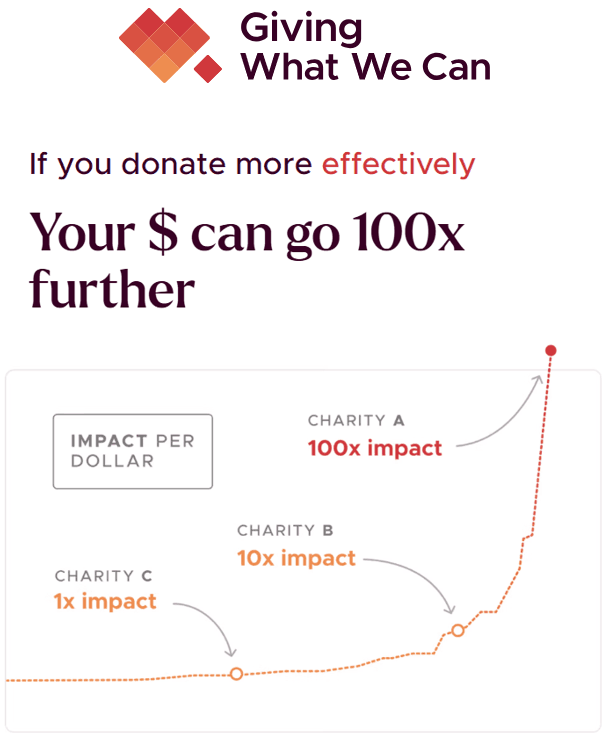
While this metrics-based approach may sound compelling, it ultimately fails due to several key issues.
Issue 1: Most impact metrics from charities cannot be verified.
A charity might claim it helped 30 million animals or saved 50,000 lives—but how could donors verify if that's true?
In most cases, donors have no way to confirm that claimed impact actually happened. As a result, false metrics are practically indistinguishable from true ones.
Issue 2: Charities have an incentive to inflate impact metrics.
Charities receive more money if they advertise higher impact metrics.
If a charity helped 1,000 penguins, they can simply claim they helped 2,000. No one has the ability to verify the number of penguins they helped, and the charity will receive more donations for advertising a bigger metric.
Issue 3: Lying allows impossibly high impact metrics.
Lying allows charities to achieve impact metrics that are higher than what is physically possible. As a result, the end state of metrics-based donating is a system in which:
- Liars create impossibly high impact metrics that no honest charity can compete with.
- Donors donate to the liars.
(Note: contrary to common belief, relying on charity evaluators does not fix any of these issues.)
Conclusion
In the end, there are no shortcuts. A donor must consider the beneficiary, strategy, and execution of a charity in order to donate responsibly.
To receive updates when we publish new articles, subscribe to our newsletter below for free.