Lab-Grown Meat Might Never Work—But It's Still Worth Trying
Accurate as of: Jul 17, 2026
At face value, lab-grown meat is a promising concept. If scaled, it would allow people to continue to eat meat without any animals having to suffer.
However, whether lab-grown meat can ever be scaled remains unclear, and despite what companies are claiming, the technology appears to be quite far from commercial viability.
Concern 1: Big Claims, No Proof
For years, headlines have proclaimed that lab-grown meat is getting drastically cheaper. One year, headlines say costs have been cut to under $20 a pound, the next less than $5.
But despite all of the headlines, we still see virtually zero lab-grown meat in grocery stores. Why is this?
Because the numbers aren't real. They're simply projections from theoretical models that have never been validated.
With models, dropping the price of lab-grown meat from $50/lb to $5/lb is as simple as changing a few assumptions in a spreadsheet. And given that doing so allows companies to make headlines and raise millions in funding, it's no surprise that projected costs keep getting better and better.
If someone could actually produce lab-grown meat at such low prices, they would have a multi-billion dollar business. So why hasn't anyone done it yet?
Probably because they can't.
Concern 2: Investors Are Out
In 2021, investors put nearly a billion dollars into lab-grown meat. But by 2025, global investment fell to $65 million—a 93% drop.
These low levels of investment are especially concerning given that over a trillion dollars are spent on meat each year. There's a lot of money to be made if lab-grown meat works out, but in 2025 global investment in lab-grown meat was less than 0.009% of the meat market.
This suggests investors think it is very unlikely that lab-grown meat achieves commercial viability in the near future.
Concern 3: Some Inventions Never Become Economically Viable
Many products can theoretically be made in labs, but in practice are far too expensive to produce. For example, scientists first created gold in a lab in 1941. But over 80 years later, virtually zero gold is produced in labs because it remains significantly cheaper to dig it out of the ground.
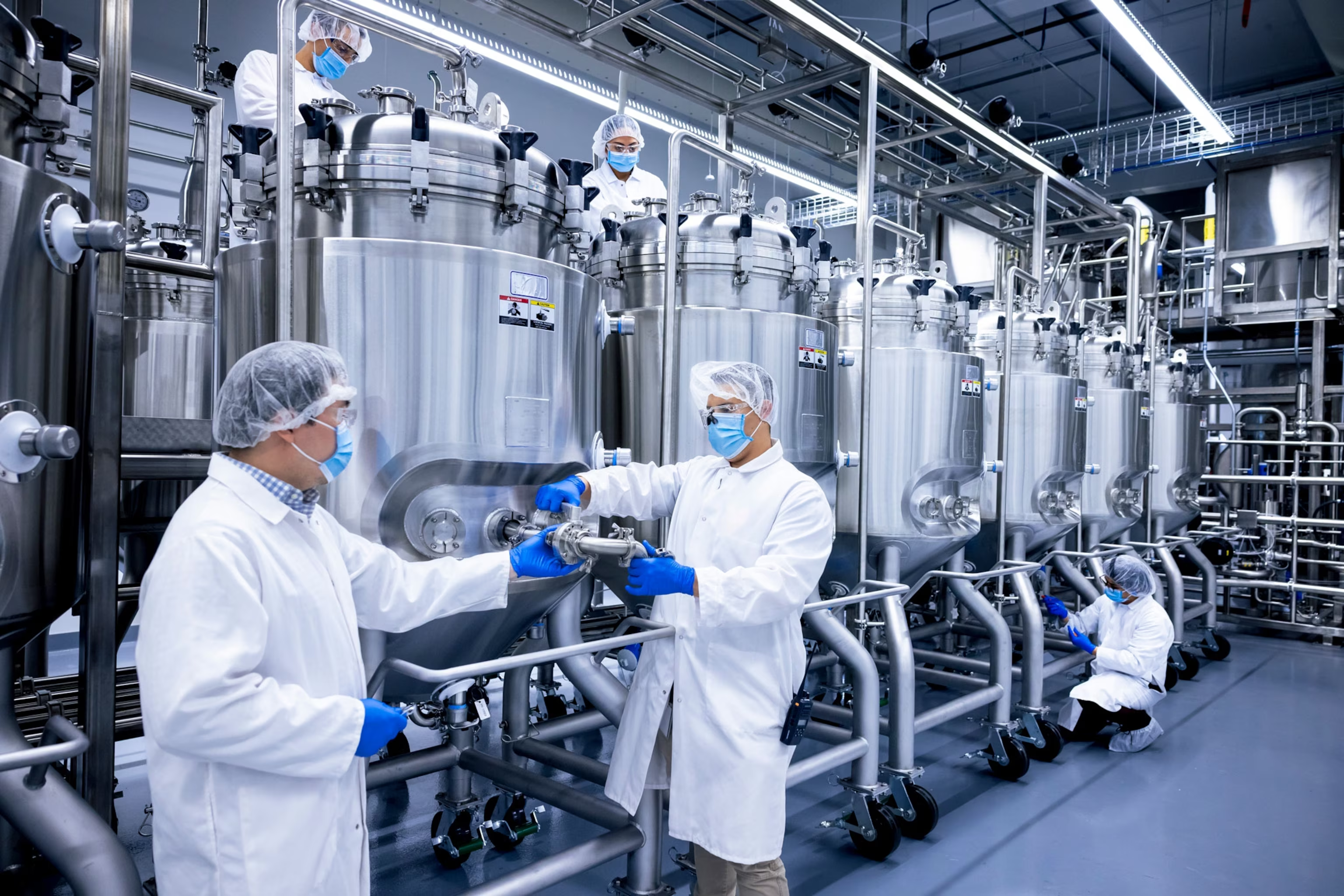
Lab-grown meat faces a similar problem. Conventional meat production is extraordinarily cheap — you put chickens in a shed, drop corn on the ground, and let biology do the work. Competing with this by growing meat in sterile factories with large bioreactors may not just be difficult, it may be impossible.
Lab-Grown Meat is Still Worth Trying
Despite all of its shortcomings, lab-grown meat is still one of the most plausible ways to end factory farming. The field is relatively young, and technological advancement over long time horizons is extremely unpredictable.
Additionally, since there is no clear path to profitable lab-grown meat in the short term, nonprofit research is likely to be important to its development.
For these reasons, we still consider funding lab-grown meat development to be a promising donation opportunity.
That said, we don't expect lab-grown meat to be commercially viable in the near future, and we believe there is a significant risk that it will never replace conventional meat.
To receive updates when we publish new articles, subscribe to our newsletter below for free.
Related Articles

References
7 euros per kg converts to roughly 4 dollars per pound.
Note: the metric provided in this article is market size, not market cap. Additionally, since the market size in 2025 exceeded $1 trillion while global investment in lab-grown meat was less than $70 million, the total global investment in lab-grown meat in 2025 was less than 0.009% of the meat market.
Note: the early versions of lab-made gold were bad (similar to the early versions of lab grown meat). Today, high-quality gold can be made in a lab, but it is still far too expensive to scale.